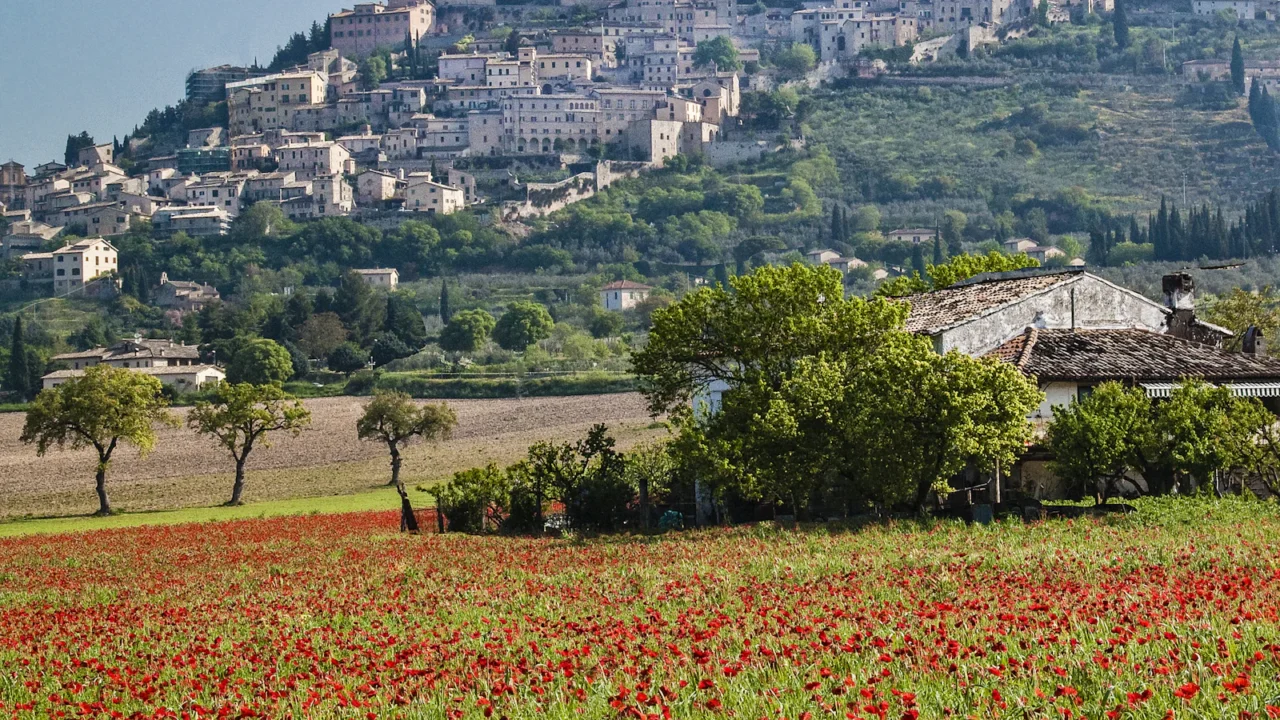
Foreigners can buy property in Umbria on the same terms as Italians: citizens of the EU and of most other countries, including the United States, the United Kingdom, Canada and Australia, can buy a house, a farmhouse or land, and the purchase is completed by a deed signed before an Italian notary. What makes Umbria different is the property itself: many homes are old stone farmhouses in an earthquake area, often with farmland around them, so the checks before you sign matter more than the paperwork.
This guide explains, from the point of view of an Italian lawyer, who can buy, what houses cost in Umbria today, which checks to make on a rural property, how earthquakes and farmland rules affect a purchase, and what to know if you plan to rent the house out. Our office is in Sansepolcro, in Tuscany, about 15 km from Città di Castello: the Upper Tiber Valley between Tuscany and Umbria is where we work every day.
- Who can buy: EU citizens, foreigners legally resident in Italy and citizens of countries with reciprocity (including the US, UK, Canada and Australia).
- Average asking price (October 2026): about €1,196 per m² in Umbria, against €2,711 in Tuscany (Immobiliare.it).
- Key checks: planning and cadastral compliance, structural and seismic condition, farmland pre-emption rights, landscape constraints.
- Residence: buying a house does not give you the right to live in Italy; non-EU buyers need a visa.
1. Can a foreigner buy property in Umbria?
Yes. Italian law (article 16 of the preliminary provisions to the Civil Code) allows foreigners to buy property in Italy under the condition of reciprocity: a citizen of a country where Italians can buy property may buy in Italy. The condition does not apply to citizens of the European Union and the European Economic Area, or to foreigners who hold a valid Italian residence permit. For US, British, Canadian and Australian citizens reciprocity is recognised, so they can buy in Umbria as freely as in the rest of Italy. If you are American, read also our guide on buying a house in Italy as an American.
Before signing anything you need an Italian tax code (codice fiscale), which you can request from the Italian consulate in your country or from the Agenzia delle Entrate in Italy. You do not need to be resident in Italy, and you do not need an Italian bank account to sign the deed, although in practice it makes paying taxes and bills easier.
2. How much does a house in Umbria cost?
According to Immobiliare.it Insights, in October 2026 the average asking price of homes for sale in Umbria was about €1,196 per square metre, up 2.2% in a year. These are asking prices, not final sale prices, and they vary a lot with the condition of the building: a farmhouse to be restored can cost a fraction of a renovated one in the same village.
| Area | Average asking price, October 2026 |
|---|---|
| Umbria (region) | €1,196 per m² |
| Province of Perugia | €1,260 per m² |
| Province of Terni | €1,024 per m² |
| For comparison: Tuscany (region) | €2,711 per m² |
| For comparison: Province of Arezzo (Tuscany) | €1,584 per m² |
Source: Immobiliare.it Insights, residential sale prices, October 2026. Remember to add the purchase taxes and the notary, agent and technician fees to the price: we explain them, with a worked example, in our guide on the costs of buying a house in Italy.
3. The buying process, step by step
- Offer. Through the agent you usually sign a written offer (proposta d’acquisto), often irrevocable for a few weeks and with a deposit. Once the seller accepts it, it can already bind you: have it read before you sign.
- Preliminary contract (compromesso). Buyer and seller agree price, deadlines and conditions, and the buyer pays a deposit. The contract must be registered with the Agenzia delle Entrate within 20 days (30 days if signed before a notary).
- Checks. Between the offer and the deed your lawyer and a surveyor (geometra) or engineer check title, mortgages, planning and cadastral compliance and the state of the building (section 4).
- Deed (rogito). It is signed before a notary chosen by the buyer, who checks the title and collects and pays the purchase taxes. If you do not speak Italian, an interpreter is needed. If you cannot travel, you can sign through a power of attorney.
- After the deed. Transfer the utilities, register for the waste tax (TARI) and, if the house is a second home, pay the annual property tax (IMU).
4. Checks on an Umbrian farmhouse or village house
Most foreign buyers in Umbria look at stone farmhouses (casali), houses in medieval villages or country homes with some land. These are the checks we make before the preliminary contract, not after:
| What to check | Why it matters |
|---|---|
| Ownership, mortgages, liens, court proceedings | The property must pass to you without mortgages or other charges, or these must be cancelled at the deed. |
| Planning compliance (conformità urbanistica) | The deed must state the building permits or, for buildings started before 1 September 1967, a declaration of that date; otherwise it is void (article 46 of Presidential Decree 380/2001 and article 40 of law 47/1985). Extensions, porches or outbuildings without permits are common in old farmhouses. |
| Cadastral compliance (conformità catastale) | The cadastral plans must match the real building (law 52/1985, article 29): otherwise the deed cannot be signed until they are updated. |
| Structure and earthquake safety | The whole of Umbria is an earthquake area: see section 5. |
| Landscape constraints | Land within 300 metres of a lake (such as Trasimeno) or 150 metres of a river, woods and land above 1,200 metres in the Apennines are protected (article 142 of Legislative Decree 42/2004): works and pools need a landscape permit. |
| Farmland and pre-emption rights | Neighbouring farmers may have a right to buy the land before you: see section 6. |
| Access, water and drains | Private access roads, wells and septic systems in the countryside need rights of way and permits that must be checked on paper. |
| Energy performance certificate (APE) | It is required for the sale and must be attached to the deed (Legislative Decree 192/2005). |
5. Earthquakes: what to check before buying
The Umbria Region describes its whole territory as having a high seismic hazard, and the 2016-2017 earthquakes hit the Valnerina area (Norcia, Cascia, Preci) hard. This does not mean you should not buy: it means that the building itself must be checked by a technician, and that some questions must be asked in writing before the preliminary contract.
- Structural survey. Ask an engineer or surveyor to check walls, roof and floors, and any cracks or past repairs.
- Past earthquake damage and public grants. Ask whether the building was damaged by an earthquake and whether it received public reconstruction contributions: if so, check that the works were completed and certified and whether the grant carries obligations that pass to the buyer.
- Renovation. Structural works in an earthquake area must be filed with the regional technical offices before they start (articles 93-94 of Presidential Decree 380/2001): plan time and costs for this if you buy a house to restore.
6. Farmland, olive groves and pre-emption rights
Many Umbrian houses are sold with land: an olive grove, a vineyard or a few hectares of fields. When agricultural land is sold, the farmer who rents it and, in certain cases, the neighbouring farmers who cultivate their own land (coltivatori diretti confinanti) have a legal right of pre-emption (law 590/1965, article 8, and law 817/1971, article 7). They must be offered the purchase at the same price before the sale. If this is not done, a farmer with the right can later take over the land by paying the price (retratto), within one year from the transcription of the deed in the land registers.
Whether the right applies depends on how the land is classified, how it is used and who the neighbours are: it must be checked case by case, and the notice to the farmers must be sent correctly. This is one of the main reasons to have a lawyer on your side when you buy a country property.
7. Renting out your house in Umbria
If you plan to rent the house to tourists when you are not there, check the rules before you buy: holiday rentals in Umbria are regulated by the regional tourism law (Regional Law no. 8 of 10 July 2017) and its regulation, and every property rented for short stays needs the national identification code (CIN). Some uses, such as an agriturismo, are possible only if specific agricultural requirements are met. Rental income is taxed in Italy: for your own country’s taxes, speak to a tax adviser there.
8. Where foreign buyers look in Umbria
- Upper Tiber Valley (Città di Castello, Umbertide, Montone, Citerna, San Giustino): on the border with Tuscany, close to Sansepolcro and Arezzo.
- Lake Trasimeno (Castiglione del Lago, Passignano, Tuoro, Magione): lake views and the landscape constraints that come with them.
- Perugia, Assisi and Spello: historic towns with services and an airport nearby.
- Todi and Orvieto: hill towns in south-west Umbria, an hour or so from Rome by train or car.
- Spoleto, Trevi and the Valnerina: olive groves and mountains; in the Valnerina, check the earthquake history of each building.
If you are also looking at homes on the Tuscan side of the border, read our guide on buying property in Tuscany.
British buyers: what changed after Brexit, from the 90-day rule to powers of attorney signed in the UK, is explained in our guide to buying property in Italy from the UK.
9. Frequently asked questions
Can foreigners buy property in Umbria?
Yes. EU citizens, foreigners legally resident in Italy and citizens of countries with reciprocity, including the US, UK, Canada and Australia, can buy property in Umbria on the same terms as Italians. You need an Italian tax code, and the purchase is completed by a notary deed.
How much does a house in Umbria cost?
In October 2026 the average asking price was about €1,196 per square metre in Umbria (€1,260 in the province of Perugia, €1,024 in the province of Terni), according to Immobiliare.it. Prices depend heavily on condition: a farmhouse to restore costs much less than a renovated one.
Is Umbria cheaper than Tuscany?
On average, yes: in October 2026 the average asking price was about €1,196 per square metre in Umbria and €2,711 in Tuscany (Immobiliare.it). Areas close to the border, such as the Upper Tiber Valley and Lake Trasimeno, have their own prices, so compare houses of the same type and condition.
Is it safe to buy a house in an earthquake area in Umbria?
The whole of Umbria is an earthquake area, so the building must be checked by an engineer or surveyor before you sign. Ask in writing about past earthquake damage, repairs and any public reconstruction grants, and plan the seismic filings needed for structural renovation.
Do I need a lawyer to buy a house in Umbria if there is a notary?
It is not compulsory, but the notary is a neutral public official who checks the deed, not your adviser in the negotiation. A lawyer acting for you reviews the offer and the preliminary contract before you sign, coordinates the technical checks and protects you on issues such as farmland pre-emption rights.
Does buying a house in Umbria give me residency?
No. Buying a house in Italy does not give you a right to live here. Citizens of non-EU countries who want to move to Italy without working usually apply for the elective residence visa for Italy, where the house can be used as proof of accommodation.
10. How we can assist you
We assist foreign buyers in English, remotely by email and video call and in person in Sansepolcro, on the border between Tuscany and Umbria. We read the offer and the preliminary contract before you sign, coordinate the surveyor’s checks on title, permits and structure, check farmland pre-emption rights, prepare the power of attorney if you buy from abroad and attend the deed with you. Our fees are agreed in writing before work begins. We call you back within one working day, at a time that suits your time zone (phone, WhatsApp or video call). Learn more about our English-speaking lawyer in Italy service.
Tell us about the property you are looking at in Umbria
Fill in the form below (fields marked * are required), or contact us directly: info@studiolegalestoppa.it · +39 389 960 7564 · WhatsApp.

Lawyer (Avvocato) in Sansepolcro and Arezzo, Tuscany · property purchases, real estate and civil law · assists English-speaking clients
This guide contains general information updated to November 2026 (sources: article 16 of the preliminary provisions to the Italian Civil Code; Presidential Decree 380/2001, articles 46, 93 and 94; law 47/1985, article 40; law 52/1985, article 29; Legislative Decree 42/2004, article 142; Legislative Decree 192/2005; law 590/1965, article 8, and law 817/1971, article 7; Umbria Regional Law no. 8 of 10 July 2017; Umbria Region, resolution no. 1112 of 18 September 2012 on seismic risk prevention; Agenzia delle Entrate; Immobiliare.it Insights, October 2026). Every purchase is different: it is not legal or tax advice for your specific case.